
Both sides of the AI openness war are arguing about the wrong axis.
One camp tells us that safety lies in distribution: put the weights in everyone’s hands, let a million systems check and balance each other, and no single actor, corporate, governmental, or artificial, can dominate the rest. The other camp tells us that safety lies in control: the frontier is too dangerous to hand out, capability must be gated, and the world may soon need tools to deliberately slow the pace of development itself. Both camps are staffed by serious people. Both have arguments I cannot dismiss. And both, I have come to think, are fighting over a question that will not decide the future they are fighting about.
I should say at the outset what kind of essay this is, because it is not the kind we have been getting. I am not here to tell you which camp is wrong. My claim is more uncomfortable than that: nobody is wholly right, everybody is partly wrong, and, this is the part we keep forgetting, that is the normal condition of thinking about anything new. We develop ideas together, usually by arguing, and the arguing works only if each side quietly accepts that it might lose on the merits. The AI debate has been losing that quality. Positions have hardened into identities. Manifestos read like declarations of war. Each camp now explains the other’s motives rather than answering the other’s arguments. Whatever the technology does to us, that habit will hurt us first.
So let me make my case for the wrong axis, and then for the humility.
What the operating system wars actually taught us
There is a version of recent history that both AI camps should sit with, because each remembers only half of it.
Through the 1990s and 2000s, technologists fought a war over operating systems that felt, at the time, existential. Proprietary systems, licensed, closed, controlled by a single vendor, against free and open-source software that anyone could inspect, modify, and redistribute. The rhetoric was religious. One side saw open source as unserious, insecure, communist even. The other saw closed software as a moral failing, a land grab against the digital commons. Everyone assumed there would be a winner.
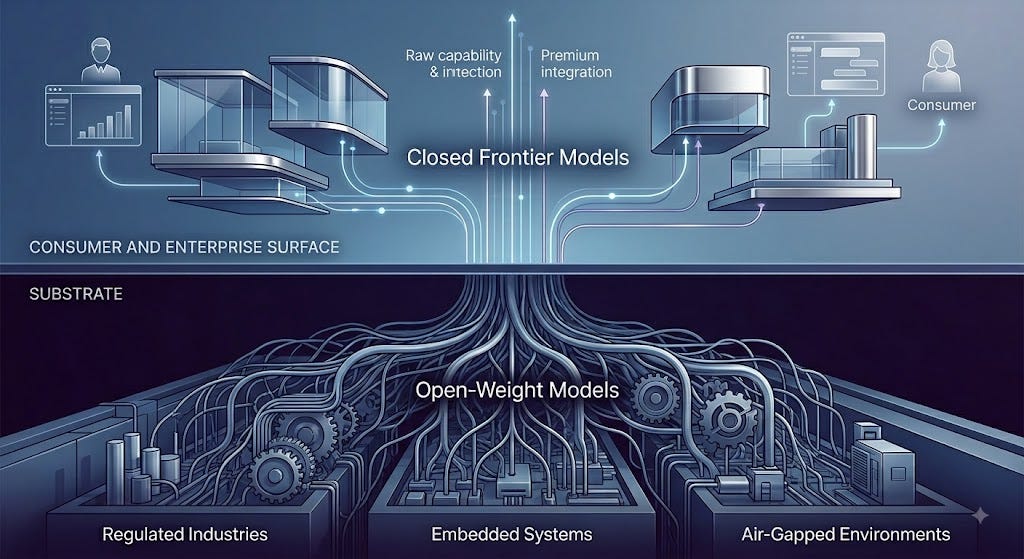
There wasn’t. There was a stratification. Open systems did not defeat Windows on the desktop; they took the substrate instead, the servers, the cloud, the phones (Android sits on a Linux kernel), the embedded devices in your car and your router. Proprietary systems kept the consumer surface, where polish, integration, and accountability commanded a premium. Nobody won the war because the war was miscast: openness and closedness turned out not to be competing answers to one question, but correct answers to different questions. A hospital’s billing system and a hobbyist’s home server have different requirements. The market did not pick a philosophy. It routed each workload to the environment that suited it.
Credit: Generated by Gemini
I think this is roughly where AI models are heading, and faster than the OS era got there. Open-weight models, the ones you can download, inspect, fine-tune, and run on your own hardware, will take the substrate: the embedded systems, the regulated industries, the air-gapped environments, the long tail of specialized applications that no vendor will ever prioritize. Closed frontier models will keep the consumer and enterprise surface, where raw capability, convenience, and a vendor to sue still matter. Companies like Cohere have already built entire businesses on a fourth quadrant the manifestos barely mention, models deployed inside the customer’s own environment, for governments and banks that need capability and custody. The hybrid is not a compromise waiting to be resolved. The hybrid is the equilibrium.
But I want to be honest about where the analogy strains, because the strain is instructive. An operating system kernel has no capability overhang: you cannot fine-tune Linux into something that helps a bad actor design a pathogen. And operating systems could be deprecated, Windows XP was retired; a published model’s weights can never be unpublished. Every open release is a ratchet. These two disanalogies are, I think, the strongest honest case the control camp has, and any distribution enthusiast who cannot state them fairly has not earned their confidence. I will come back to what follows from them. It is less than the control camp thinks, and more than the distribution camp admits.
The axis that actually matters
Here is what a decade of arguing about open versus closed has obscured: for a large and growing class of real decisions, the binding question is not whether the weights are open. It is where the weights execute, and who can be compelled to produce what runs through them.
Let me make that concrete, because I live it.
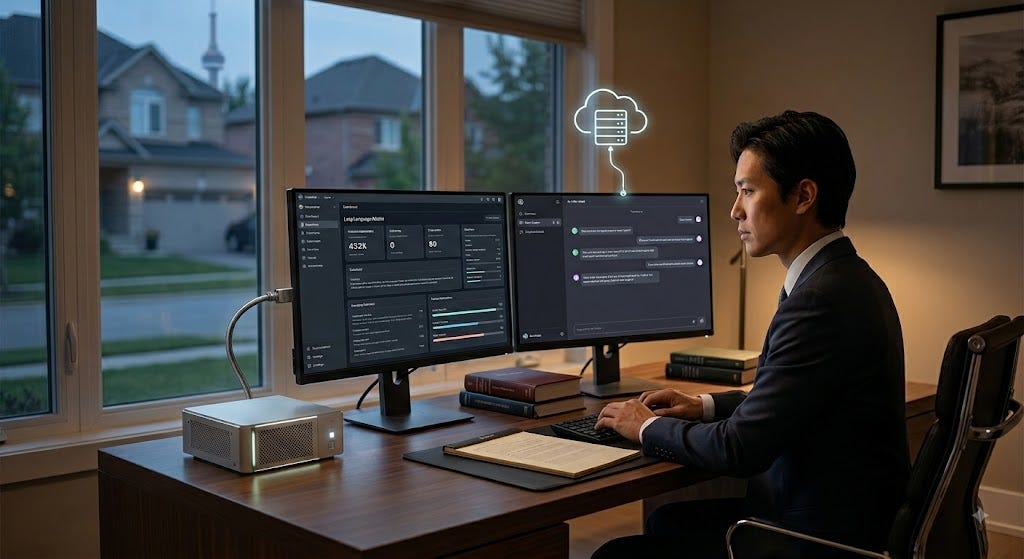
I practice law in Ontario, and like a growing number of professionals, I run two AI environments in parallel. I use a hosted frontier model daily, for research, for drafting against anonymized facts, for stress-testing arguments, because it is the most capable reasoning instrument I have ever had access to, and pretending otherwise would be a disservice to my clients. And I also run capable models on hardware I own, inside walls I control, because there is a category of material that cannot cross certain boundaries at any price, at any capability level, under any terms of service.
Credit: Generated by Gemini
That second category is not a preference. It is law. Solicitor-client privilege is the client’s right, not the lawyer’s convenience, and it survives only if confidentiality is actually maintained. Canadian privacy statutes govern where personal information may flow and what safeguards must follow it. And when data sits on infrastructure in another jurisdiction, the question of who can compel its production, under what process, before which court, with what notice, stops being philosophical. A confidentiality obligation that depends on another country’s legal process is a different obligation than the one my clients think they have.
So here is the first uncomfortable claim of this essay: for a core slice of professional work, law, medicine, parts of finance and government, hosted frontier AI is not merely disfavored. It is structurally unusable, no matter how good it gets, and a meaningful part of the professions is currently pretending otherwise. The pretense mostly takes the form of not asking the question.
Notice what this does to the openness war. The reason I can run sovereign inference at all is that open-weight models exist, that is a genuine, concrete gift from the distribution camp, and I am a direct beneficiary. But notice also that what I needed from openness was not inspectability or ideological freedom. Weights alone do not tell you what a model learned; you do not get the training data, and interpretability remains a research frontier, not a shipped feature. What I needed was custody: the ability to execute the model where the law requires the data to stay. Openness happened to be the delivery mechanism for sovereignty. It is not the same thing as sovereignty. A closed model deployed inside my own walls under contract would solve my problem too; an open model that only ran on someone else’s cloud would not.
The axis that matters is custody and compellability. Open versus closed is merely one input into it.
Adoption proves nothing
There is an argument circulating at the highest levels of this industry that deserves to be retired, and it belongs to no single company, versions of it appear in the distribution camp’s manifestos and in every product keynote. It goes: people will not adopt AI systems they do not trust; therefore, if billions of people adopt these systems, alignment with users’ interests has effectively been demonstrated. The market becomes the safety case.
The last twenty years of the internet are a controlled experiment against this claim. Billions of people adopted engagement-optimized feeds. Adoption was total, enthusiastic, and sustained, and it demonstrated nothing about whether those systems served their users’ interests, because adoption measures perceived usefulness under information asymmetry, and the asymmetry is the entire problem. A system can be genuinely useful, honestly enjoyed, and quietly optimized for someone else’s objective, all at once. Usage statistics cannot distinguish these cases. That is not cynicism; it is measurement.
This cuts in every direction, which is why I like it. The distribution camp cannot cite a billion users as evidence that distributed AI produced a balance of power. The control camp cannot cite enterprise adoption as evidence that gated AI earned its gates. And those of us building sovereign systems cannot assume that self-hosting aligns a model with our interests either, it aligns the infrastructure with our interests, which is necessary and insufficient. Alignment, in every camp, remains a claim that must be demonstrated by mechanisms, not by market share.
In defense of invention
Now the part of the optimists’ case I want to defend, because I think the critics, and I have been among them, sometimes attack it lazily.
The optimists argue that AI’s greatest contribution will be invention rather than automation: not doing existing work cheaper, but making new things possible. The standard rebuttal is to point at the labor data, and the labor data is real. The early evidence shows something specific and troubling: not mass unemployment, but a narrowing of the entry-level door, young people in exposed occupations finding it markedly harder to get their first foothold, while their seniors’ employment holds. The ladder is losing its bottom rungs, and “people will adapt” is a sentence whose costs are paid by a cohort that didn’t choose it. Anyone writing cheerfully about this moment owes that cohort more than a transition-assistance clause.
But here is what the rebuttal misses: whether AI tilts toward automation or invention is not a law of nature awaiting discovery. It is the aggregate of millions of allocation decisions, what firms build, what buyers demand, what individuals choose to attempt with the new capacity in their hands. Compute is scarce; pointing it at inventing new value and pointing it at eliminating existing wages are competing uses. The invention thesis is not a prediction. It is a direction, and directions can be chosen. That is precisely why the hybrid ecosystem matters more than either camp’s total victory: a monoculture, open or closed, narrows who gets to invent and on whose terms. A stratified ecosystem, frontier models for those who need raw capability, sovereign models for those who need custody, small models for those who need cheapness at the edge, maximizes the surface area on which invention can occur. If you believe in the invention mechanism, the hybrid is not a compromise. It is the load-bearing condition.
A blip, perhaps
Let me end the argument with a conjecture I hold loosely, and then the point I hold firmly.
For most of human history, almost nobody had an employer. The baker, the smith, the farmer, the merchant, economic life was organized around families and small crews, and a person often worked several trades at once. Mass employment inside large corporations is, on the long timeline, astonishingly recent. The economist Ronald Coase gave us the reason it happened: firms exist because coordinating through markets is expensive, and when coordination costs are high, it is cheaper to bring people inside one organization. The corporation is not a law of nature either. It is a response to transaction costs.
AI collapses coordination costs. That is arguably the most fundamental thing it does. And if the corporation is a creature of coordination costs, then as those costs fall, the equilibrium size of the firm should fall with them. We may be watching the early innings of a reversal: large organizations needing fewer people, while small crews of family and friends, armed with capability that once required departments, take back the territory. A giant firm, whatever its resources, cannot allocate attention to a million niches. A million small crews can, because attention is the one resource that distribution actually distributes. It is possible that our great-grandchildren will look at the twentieth century’s centralized mass employment the way we look at feudal land tenure, not as the natural order, but as a phase.
I said I hold this loosely, and here is why: the smith owned his forge. The one-person studio of the coming era rents its compute, its distribution, and increasingly its intelligence from a handful of very large landlords. Whether the re-smalling of economic life produces independence or a new kind of tenancy depends on exactly the axis this essay has been about, who has custody of the tools. Which is, perhaps, the real reason the openness debate matters after all: not as a safety mechanism, but as the difference between owning your forge and renting it.
The humility we cannot afford to lose
I am genuinely agnostic on the question that most animates the two camps, whether the world should build the capacity to deliberately pace this technology. I find the concern about runaway dynamics serious, and I find the counterarguments serious, and I do not believe either side can honestly price the costs of what it proposes. I suspect some of what worries us is simply coming regardless. But I have written this essay anyway, because “it’s inevitable” is itself a claim that might be wrong, and if talking is what makes it not inevitable, then talking was the right call. That is not a paradox. That is just what taking your own fallibility seriously looks like.
The pace of this technology is the standard argument against humility: we must move fast, commit hard, decide now. I think the pace is the argument for it. When the cycle time of change is shorter than the cycle time of understanding, the number of confident positions that turn out wrong goes up, not down, and the cost of having welded your identity to one of them goes up with it. The appropriate response to moving faster is holding looser: strong positions, open hands. Ask what happens if the agenda you are pushing succeeds and you were wrong. Every camp in this debate should be able to answer that question about itself. Very few of the manifestos even acknowledge it exists.
We don’t know until we know. In the meantime, the most useful thing any of us can do is argue as if the other side might be right, because on the evidence of every previous technological argument we’ve had, parts of them are.